Categories
Albright Memorial Library Lackawanna County Library System

The Great Railroad Strike of 1877 and Mayor Robert H. McKune: Epilogue (Series: Part 11)

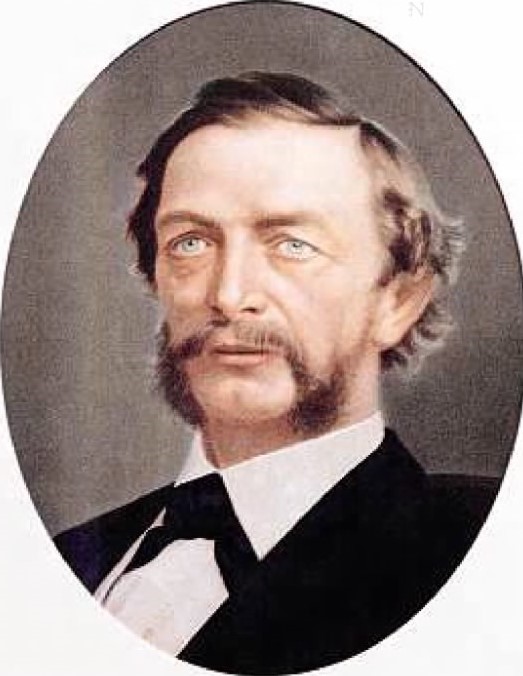
Mayor Robert H. McKune lead Scranton through the Great Rail Road Strike of 1877 without the aid of federal troops. It was the only instance of this happening in Pennsylvania. The importance of having a center of government close to the Scranton area was demonstrated through the strikes, and led the final push for the area to separate itself from Luzerne County. On August 13, 1878, Lackawanna County was formed.

The Scranton City Guard would be transformed into the Thirteenth Regiment of the Pennsylvania National Guard during the summer of 1878. Today the regiment still exists as the 109th Infantry Regiment. It has been involved in every conflict the United States has participated in since its creation in 1877, including the Spanish American War and both World Wars.

During the election of 1878, Terence V Powderly was elected mayor under the Greenback Labor Party. The strikers had used the motivation from the strikes to vote in the leader of the Knights of Labor in an effort to better their situation. The Knights of Labor’s primary demand was the creation of an eight-hour workday, but they also advocated for the end of child labor, a reformed income tax system, and companies operating under a cooperative.

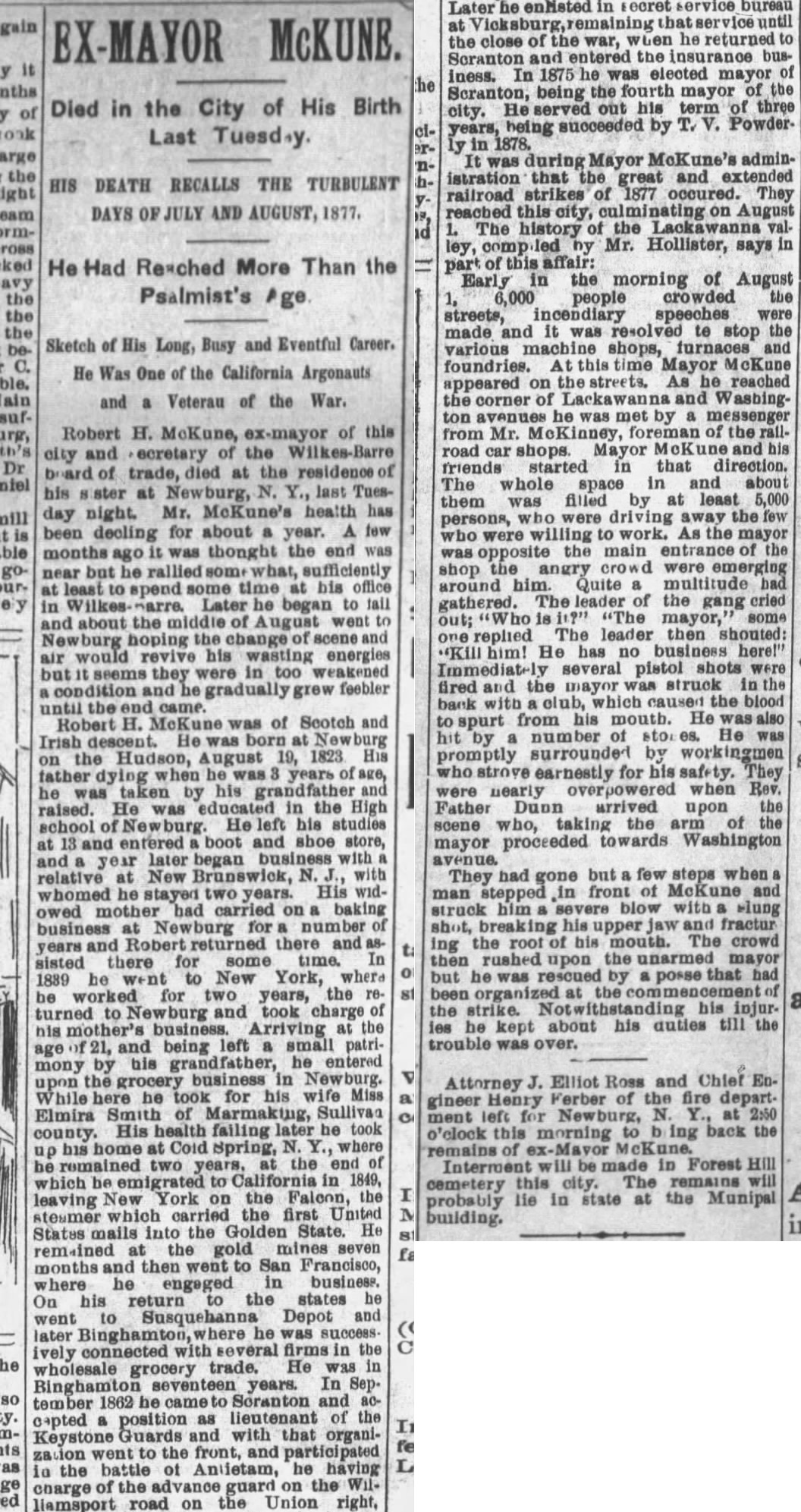
Robert McKune died of Tuberculosis on October 11, 1894 while visiting his sister in Newburgh, New York. He would be transported back to the area to be buried in Forest Hill Cemetery in Dunmore, Pennsylvania.

Scranton Times, October 11, 1894

Stop in to the Scranton Public Library to see a selection of the documents from this series in person. They are in the display case located on the second floor entrance to the Reference Department.

Categories
Albright Memorial Library Lackawanna County Library System

The Great Railroad Strike of 1877 and Mayor Robert H. McKune: Continued Troubles (Series: Part 10)

Although the events of August 1st through August 9th were the height of the activity surrounding the Railroad strike, unrest would continue. Strikers continued to threaten destruction of property, or to harm those who returned to work until their demands were met. The military presence in the city shifted from trying to calm the strikers, to actively protecting those that were working and their work places. Multiple letters found in Mayor McKune’s documents show the continued strikes and fear of violence.

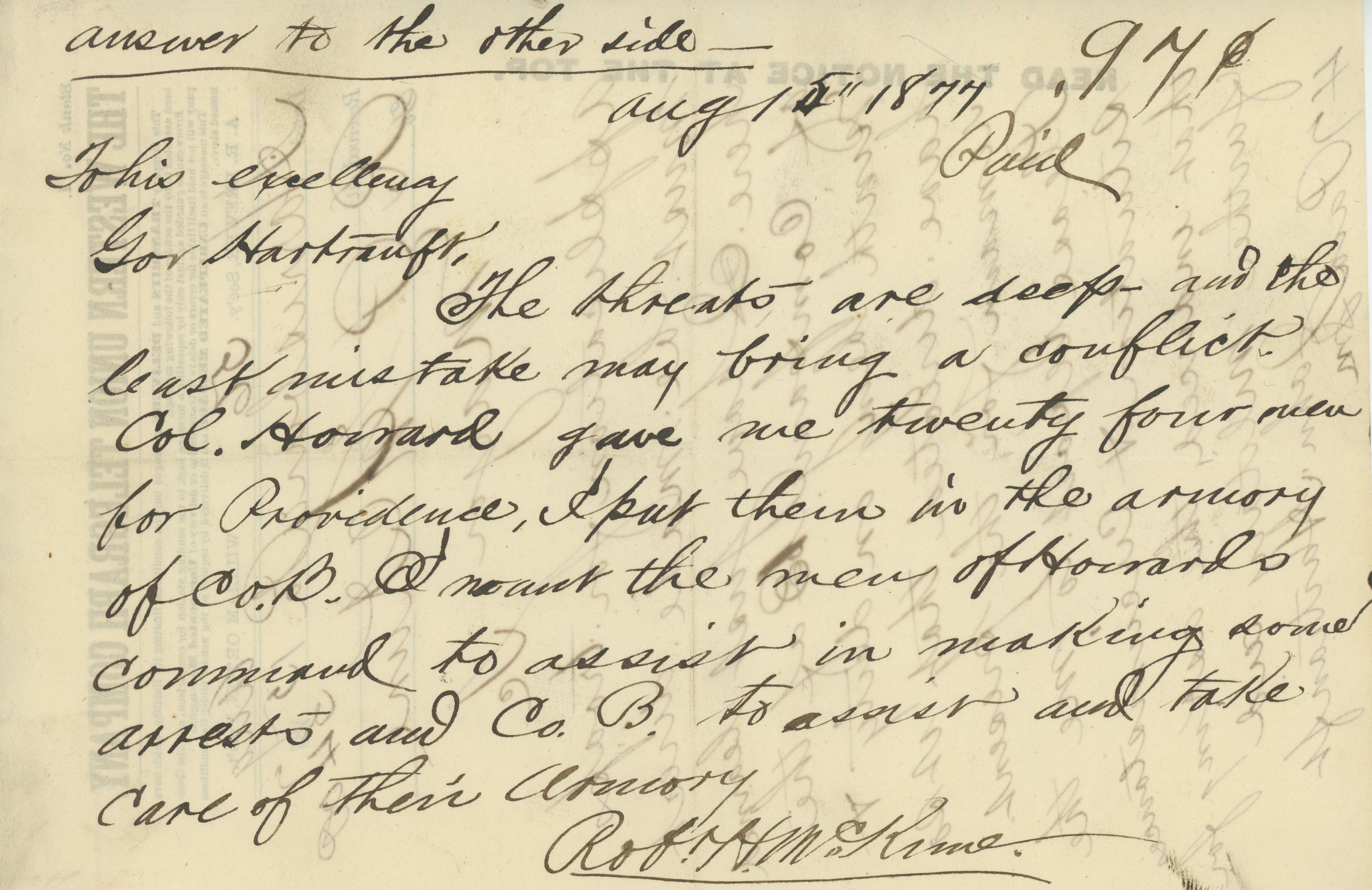
Aug 15th 1877 .97₵ Paid To his excellency Gov Hartranft, The threats are deep and the least mistake may bring a conflict Col. Howard gave me twenty four men for Providence. I put them in the armory of Co. B. I need the men of Howard’s command to assist in making sound arrests and Co. B to assist and take care of their armory. Robt. H. McKune
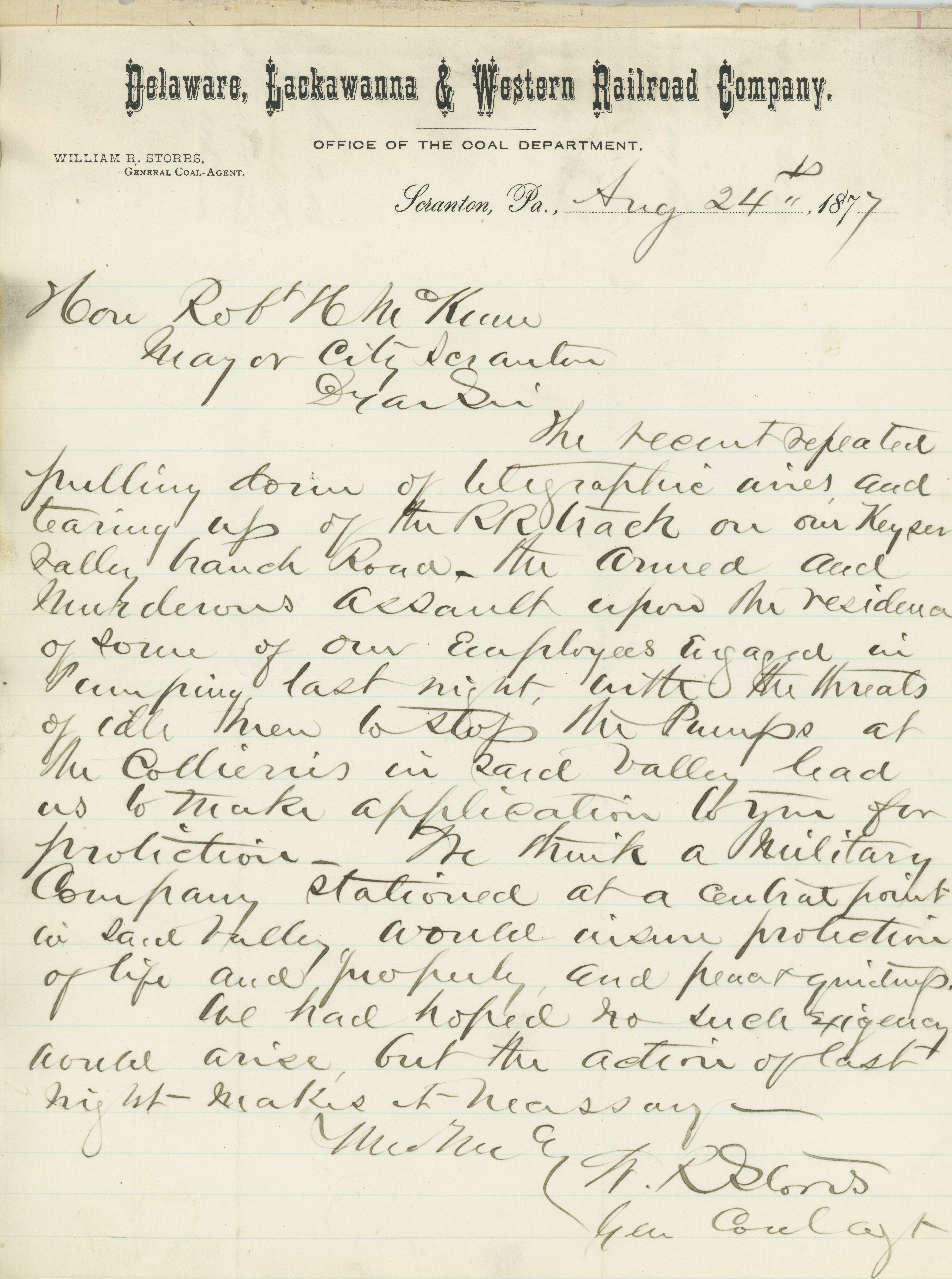
Scranton Pa Aug 24th 1877 Hon Robt H McKune Mayor City Scranton Dear Sir The recent repetitive pulling down of the telegraphic wires and tearing up of the RR track on our Keyser Valley Track Road. The armed and murderous assault upon the residence of some of our employees engaged in pumping last night with the threats of idle men to stop the pimps at the Collieries in said Valley lead us to make application to you for protection. We think a military company stationed at a central point in such valley would insure protection of life and property peace & quieting. We had hoped no such experience would arise but the action of last night makes it necessary. W.R. Storrs
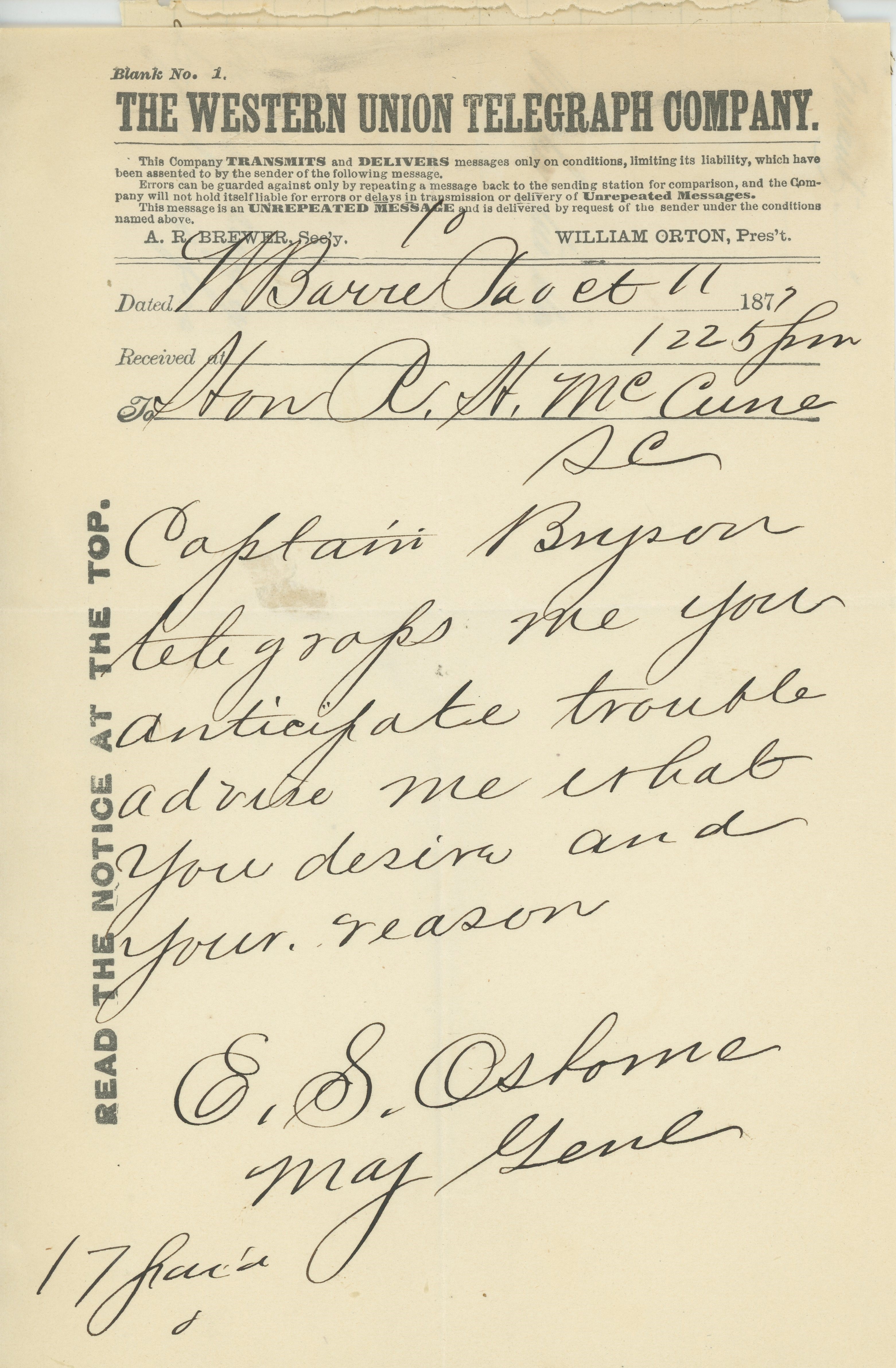
Dated: Wbarre Pa Oct 11 1877 Received: 12:25pm To: Hon R. H. McCune Sc Captain Bryson telegraph me you anticipate trouble advise me what you desire and your reason E.S. Oborne May Genl 17 Jan

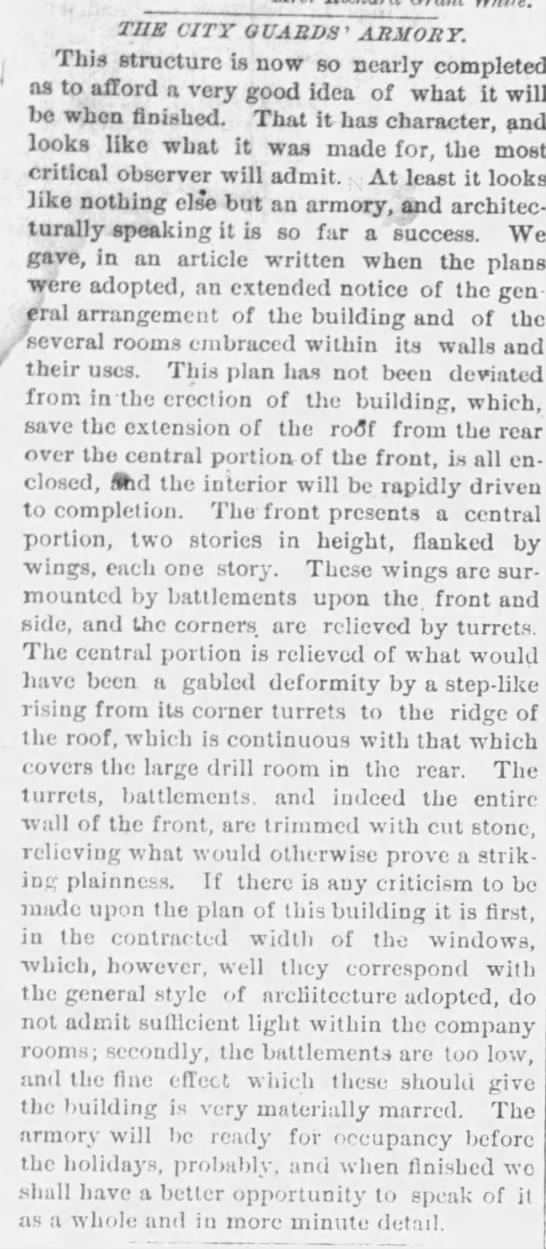
During the prolonged unease of the strikes, citizens of Scranton decided to create a permanent military presence in the city. The Scranton City Guard was comprised of over one hundred men from the city that would help keep the city safe and peaceful.  To house the guard, the Scranton Watres Armory was constructed. It would not be finished until January 31, 1878.

The Scranton Republican, December 12, 1877

After weeks of unrest, the strikes in Scranton finally came to an end on October 16, 1877. The miners agreed to return to work without any victories. Their wages would continue to be the reduced rate that originally resulted in striking. By November, the city would no longer have the presence of troops from the state or federal level.

Categories
Albright Memorial Library Lackawanna County Library System

The Great Railroad Strike of 1877 and Mayor McKune: August 9 (Series: Part 9)

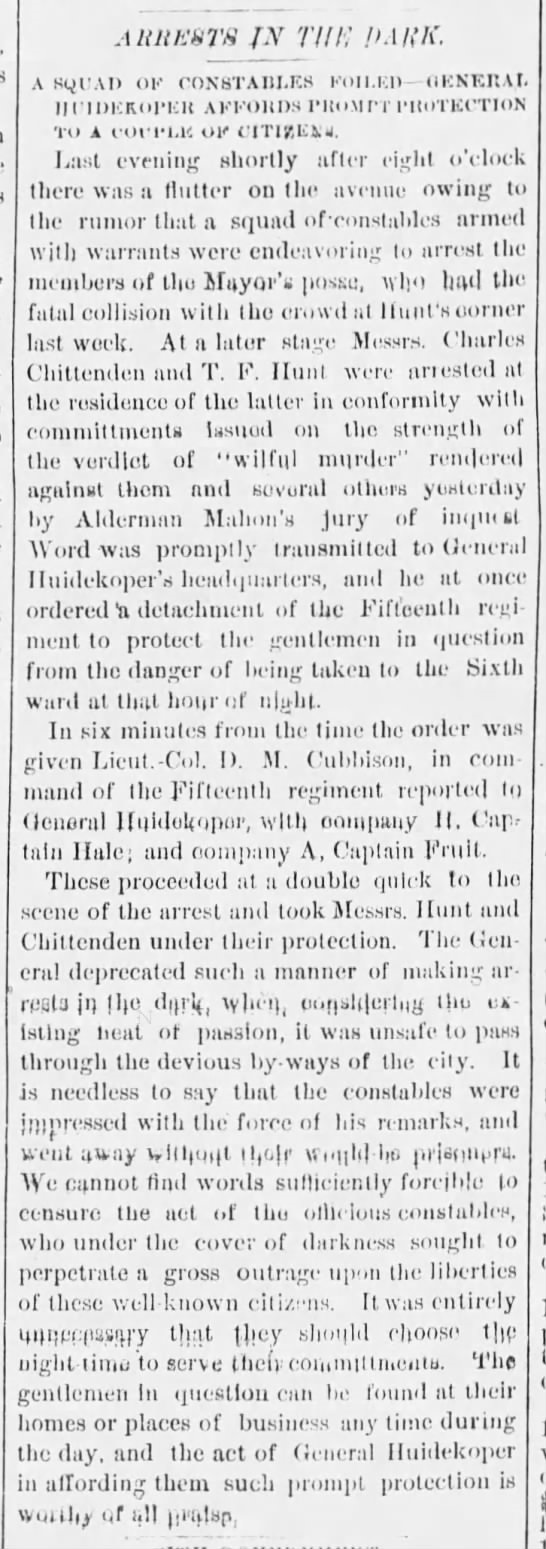
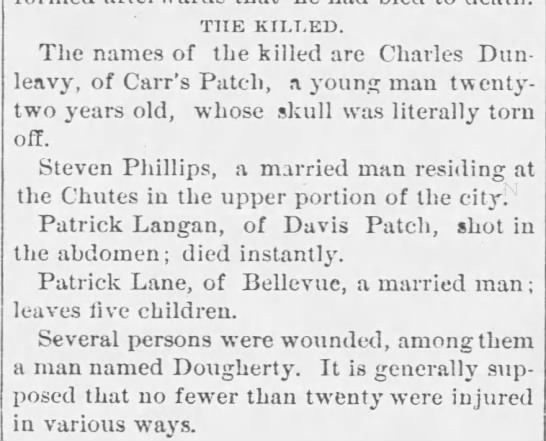
In the aftermath of the events of August 1st, Alderman Patrick Mahon issued warrants against twenty-two members of the Scranton Citizen Corps. The group, which included William Walker Scranton, Ezra Ripple, and Wharten Dickson, were charged with willful murder of Charles Dunleavy, Steven Phillips, Patrick Langan, and Patrick Lane. When the arrest warrants were carried out on August 8th, General Huidekoper sent troops to protect the men from being taken from their homes. A newspaper article from the Scranton Republican reported on the events on the morning of August 9th.

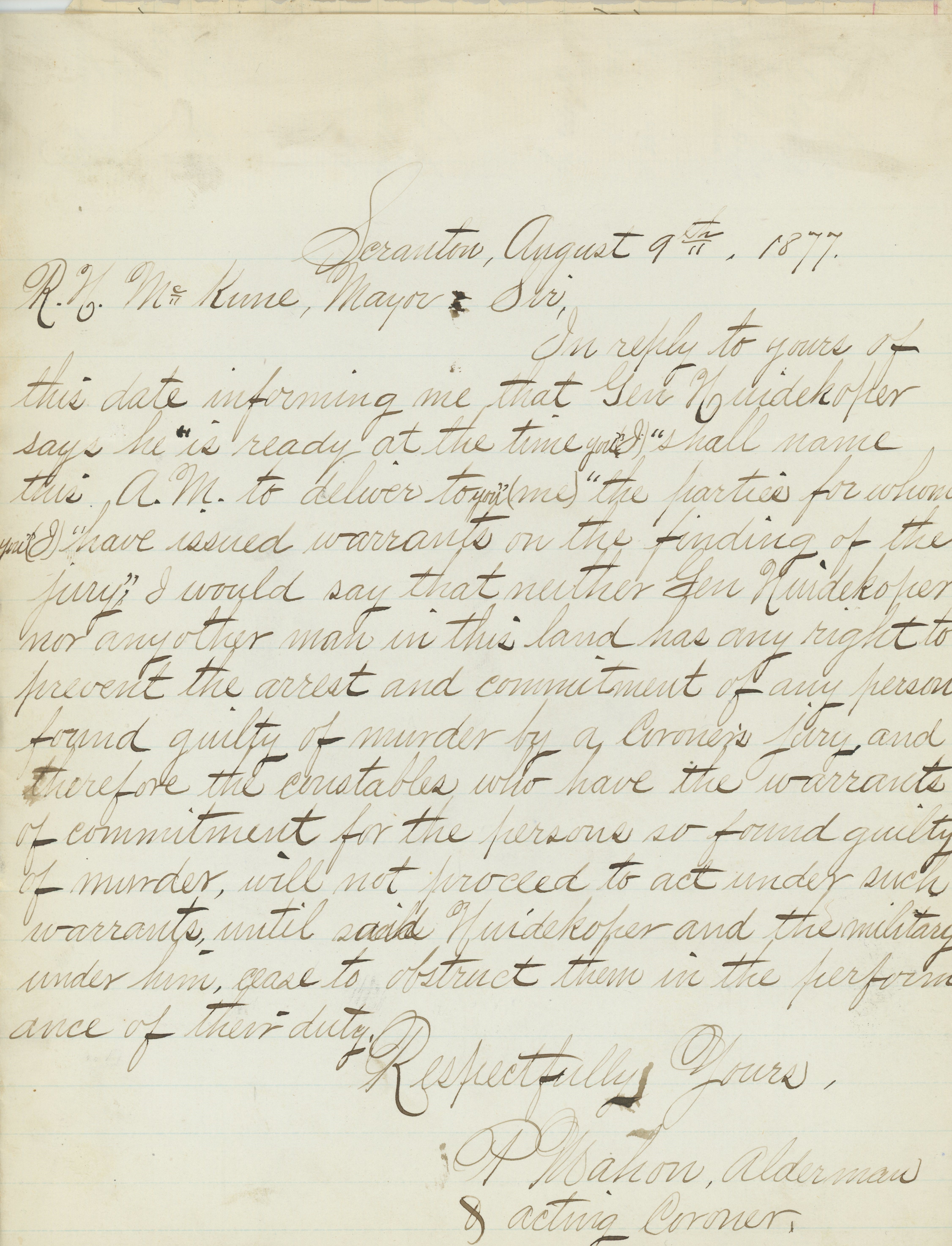
In Mayor McKune’s documents, a letter written from Alderman Mahon showing his displeasure at the actions taken by General Huidekoper to block the arrests.

H. McKune Mayor Sir, In reply to yours of this date informing me that Gen. Huidekoper says he is ready at the time you “I” shall name this A.M. to deliver to you” (me) “the parties for whom you” (I) “have issued warrants on the finding of the jury.” I would say that neither Gen. Huidekoper nor any other man in this land has any right to prevent the arrest and commitment of any person found guilty of murder by a Coroner’s jury and therefore the constables who have the warrants of commitment for the persons so found guilty of murder, will not proceed to act under such warrants until said Huideoper and the military under him cease to obstruct them in performance of their duty. Respectfully Yours, Mahon, Alderman & Acting Coroner

On August 10th, the men were released on $3,000 bail to await their trial on November 26, 1877. Only six members of the Scranton Citizen Corps would appear at the trial in Wilkes-Barre, Pennsylvania. Everyone who was arrested on the charge of willful murder was found not guilty due to the belief that the men had reacted in a heroic way when faced with a riot.

Categories
Albright Memorial Library Lackawanna County Library System

The Great Railroad Strike of 1877 and Robert McKune: August 1st (Series: Part 7)

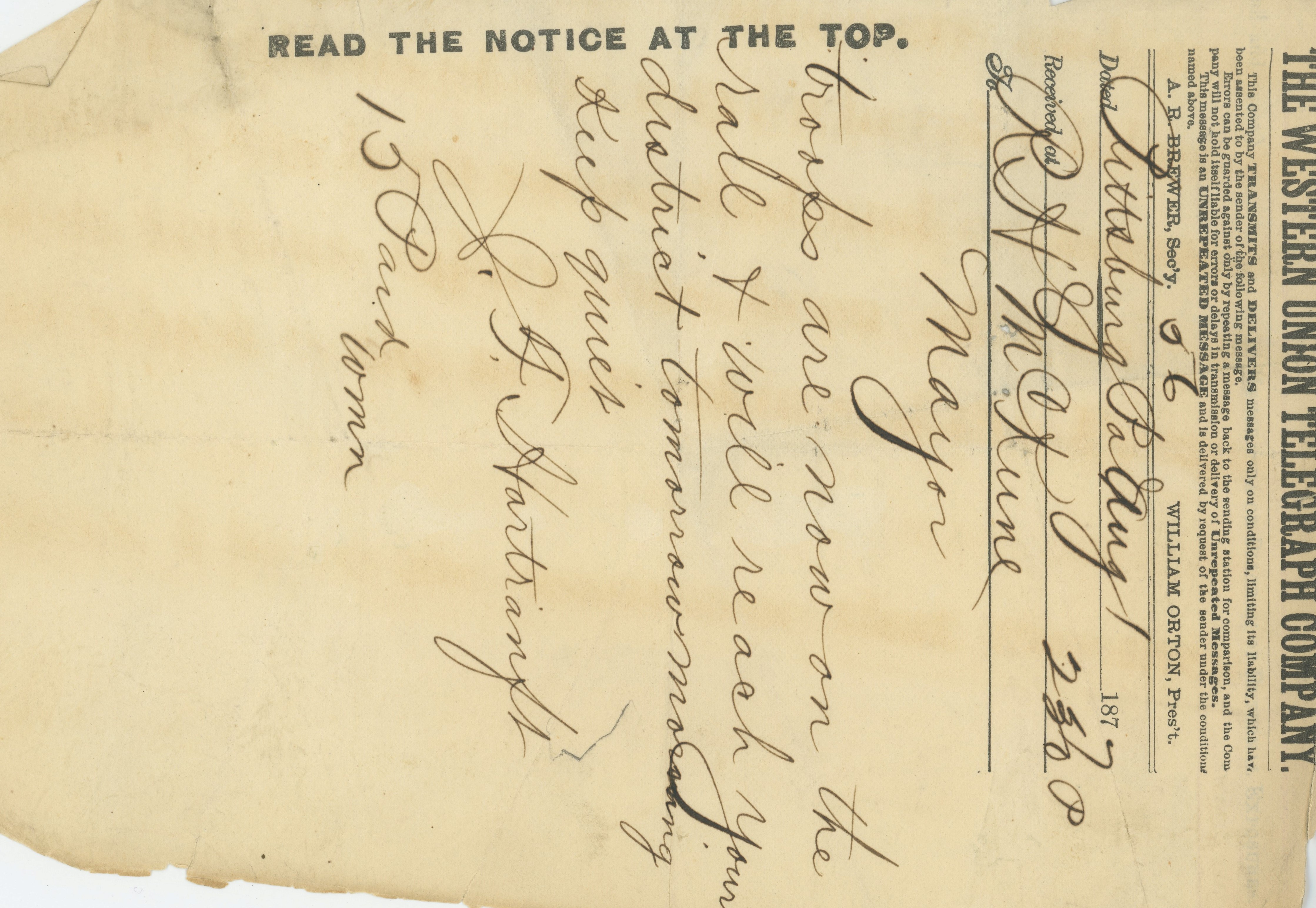
Only one item exists for August 1st in Mayor McKune’s documents, a telegram from Governor Hartranft informing the Mayor that reinforcements would be in the city soon.

Pittsburg Pa Aug 1 1877 RH McKune Mayor Troops are now on the rail & will reach your district tomorrow morning. Keep quiet J.F. Hartranft

The lack of documents from August 1, 1877 is potentially the result of it being the most eventful day during the strikes. During the morning hours, a group of a few thousand workers began to assemble near the Silkworks in the south side of Scranton. A letter allegedly signed by William Walker Scranton threatening to cut the worker’s wages to thirty five cents a day soon made its rounds throughout the group. Already angry at the recent wage cuts, the strikers split into two groups. One was marching to the Lackawanna Iron and Coal Works, which was managed by Scranton, while the other group moved towards the Delaware, Lackawanna, and Western Railroad shops downtown.

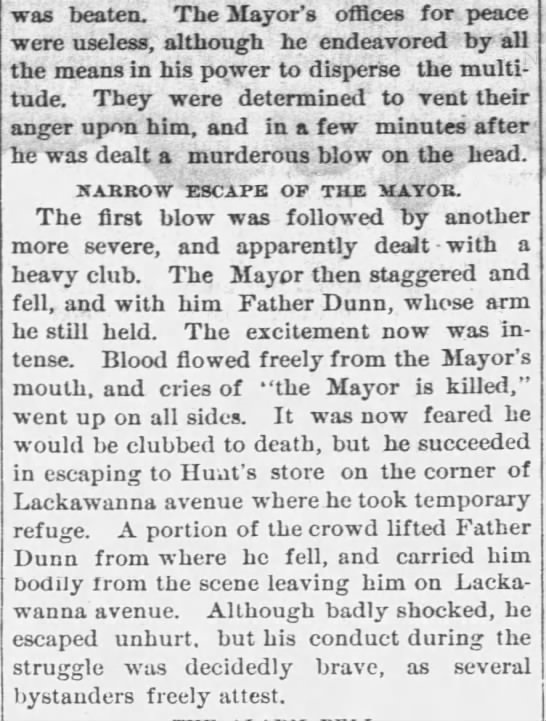
Mayor McKune, who had initially thought the gathering was more peace talks, alerted the Scranton’s Citizen’s Corp before meeting the group himself. He was able to briefly stop the progression of the group of strikers moving downtown in the intersection of Lackawanna and Washington Avenues. Aided by Father Dunn, a priest at St. Vincent Cathedral, McKune was able to calm the crowd for a brief moment before being attacked himself with a club held by one of the strikers.

By the time the Citizen’s Corps arrived on the scene, the Mayor and Father Dunn had already been attacked. Mayor McKune would give the order for the Corps to fire upon the crowd, which had previously declared him dead. After about three minutes, the shooting stopped and the strikers dispersed leaving four dead and many wounded. The exact numbers of wounded are unknown due to the strikers fears of being fired after confessing to being part of the strikers.

Categories
Albright Memorial Library Lackawanna County Library System

The Great Railroad Strike of 1877 and Mayor McKune: July 30 (Series: Part 6)

Mayor McKune’s documents on July 30, 1877 show a conflicting account of the day. Many people believed that the situation would remain peaceful, but a letter received by an anonymous source threatened fires being set at local coal mines in the coming days.

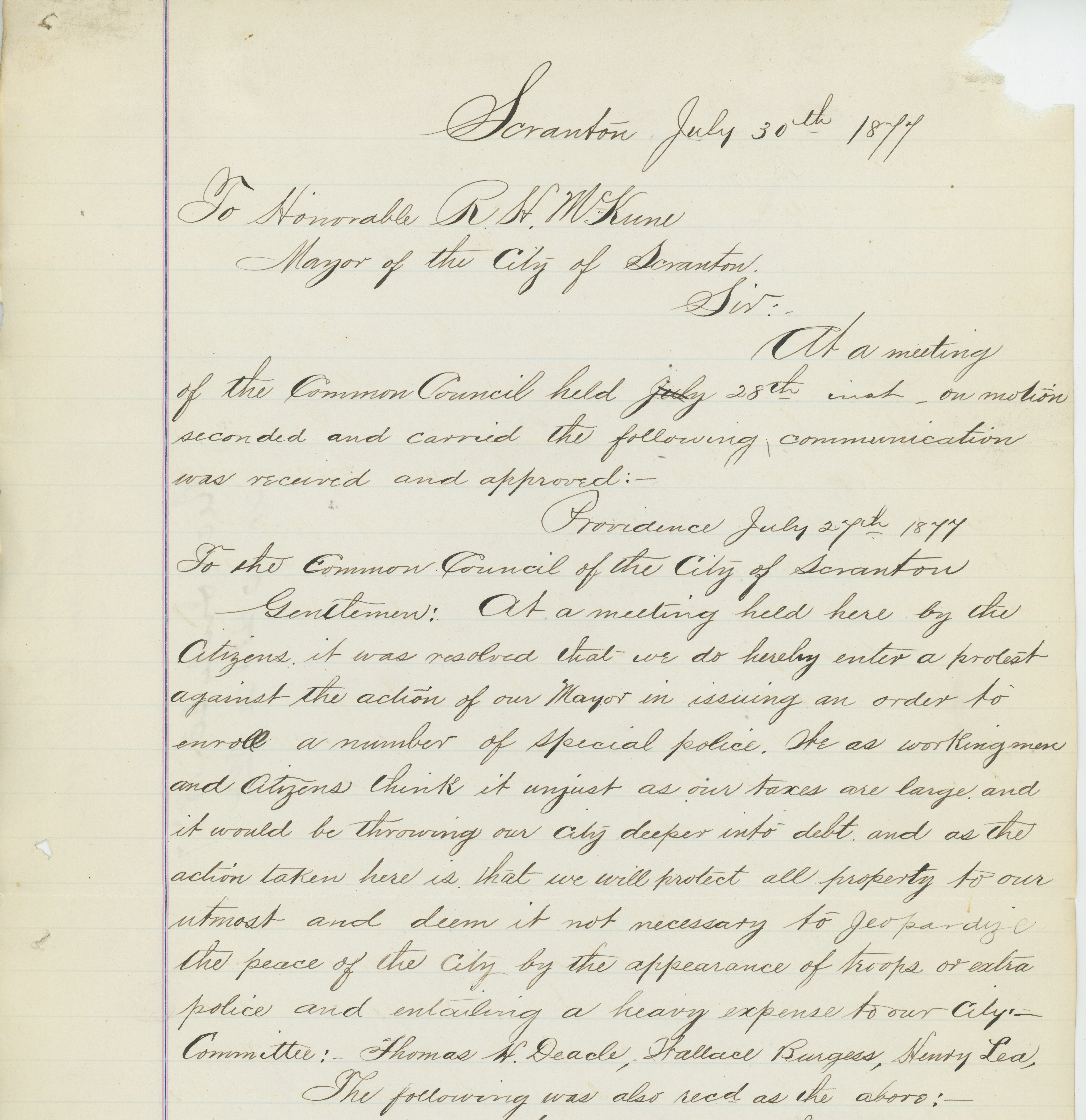
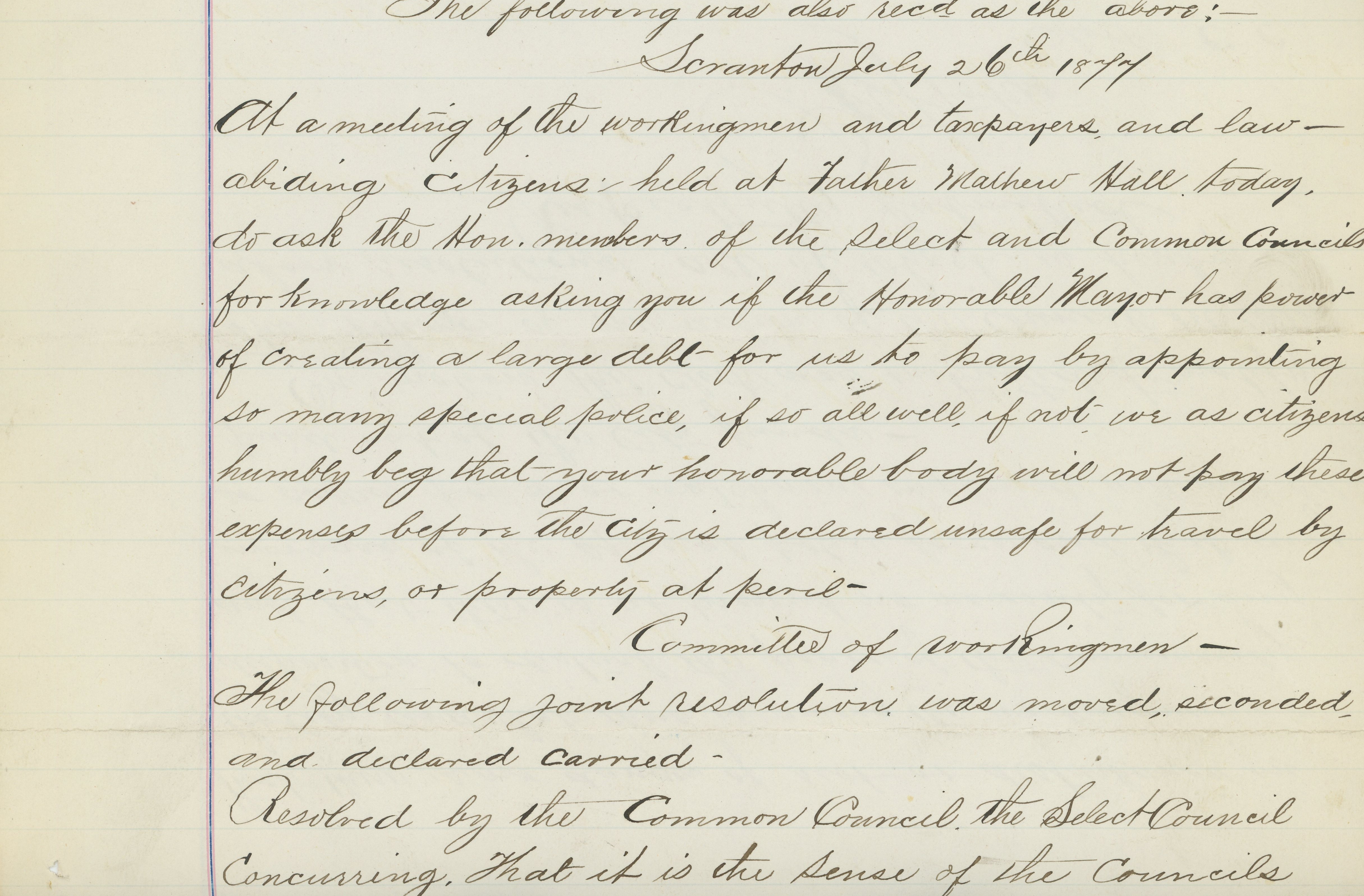
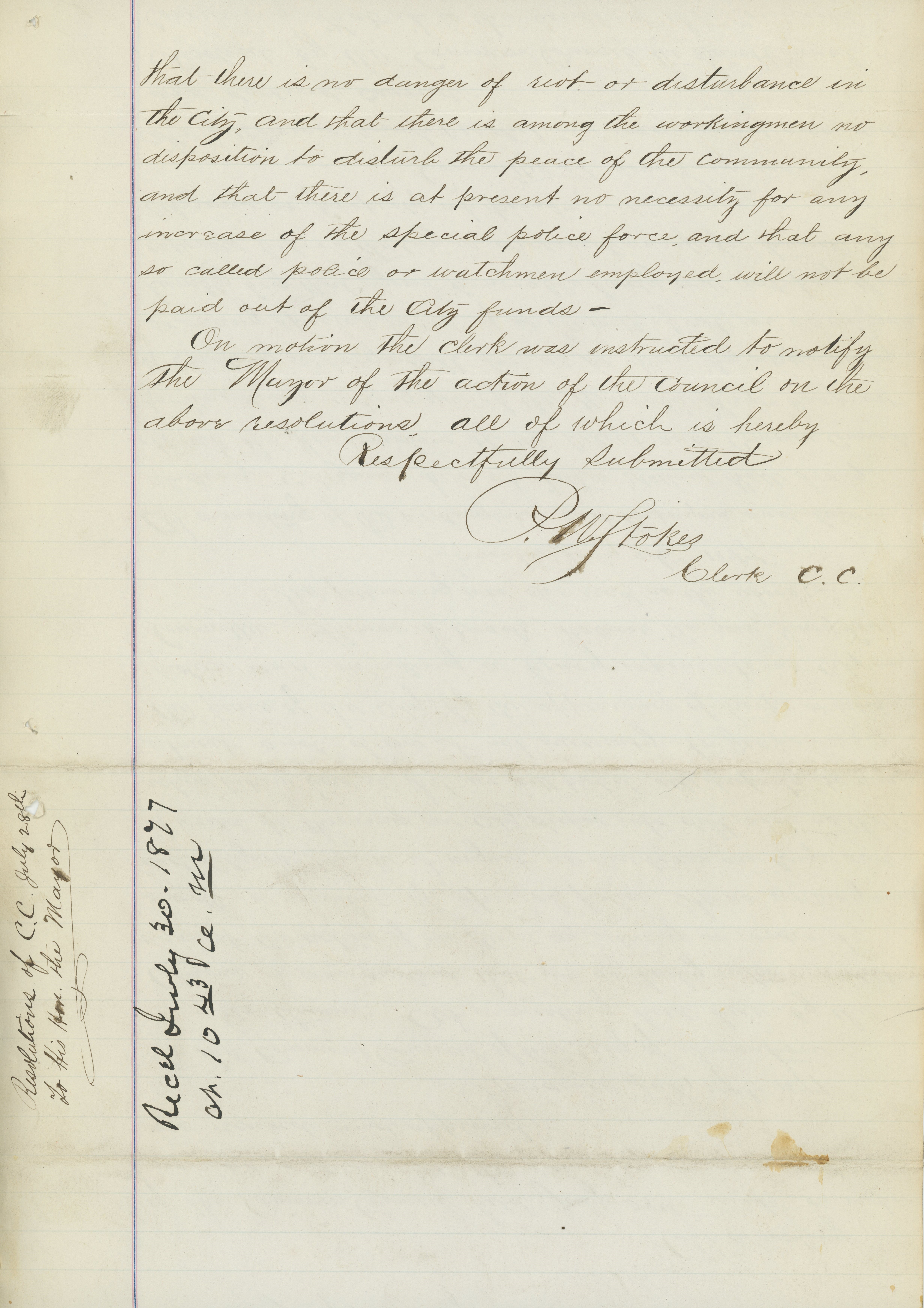
Many workers remained on strike, but some employees of the Delaware, Lackawanna, and Western Rail Road returned to work. This gave hope to many citizens who began to hold meetings in order to pass motions and resolutions against the creation of a special police force by Mayor McKune. These documents were summarized in a letter to Mayor McKune by P. W. Stokes, a clerk.

To Hon. R. H. McKune, Mayor City of Scranton Sir: At a meeting of the Common Council held July 26th inst. on motion seconded and carried the following recommendation was received and approved: Providence, July 17, 1877 To the Common Council of the City of Scranton Gentleman: At a meeting held here by the Citizens it was resolved that we do hereby enter a protest against the action of our Mayor in issuing an order to enroll a number of special police. We as workingmen and citizens think it unjust as our taxes are larger and it would be throwing our city deeper into debt and as the action necessary to jeopardizing the peace of the city by the appearance of troops or extra police and entailing a heavy expense to our city. Committee: Thomas H. Deade, Wallace Burgess, Henry Lea The following was also read as the above:
Scranton, July 26, 1877 At a meeting of the workingmen and taxpayers and law-abiding citizens held at Father Mathew Hall today do ask the Hon. Members of the select and Common Councils for knowledge asking you if the Honorable Mayor has power of creating a large debt for us to pay by appointing so many special police, if so all well, if not we as citizens humbly beg that you honorable body will not pay these expenses before the city is declared unsafe for travel by citizens, or property at peril. Committee of Workingman The following join resolution was moved seconded and declared carried: Resolved by the Common Council the Select Council concurring, that it is the sense of the Councils
that there is no danger of riot or distribution in the city and that there is among the workingmen no disposition to disturb the peace of community, and that there is a present no necessity for any increase of the special police force, and that any so-called police or watchmen employed will not be paid out of the city funds. On motion the clerk was instructed to notify the Mayor of the action of the Council on the above resolutions, all of which is hereby Respectfully submitted, PW Stokes, Clerk, C.C.


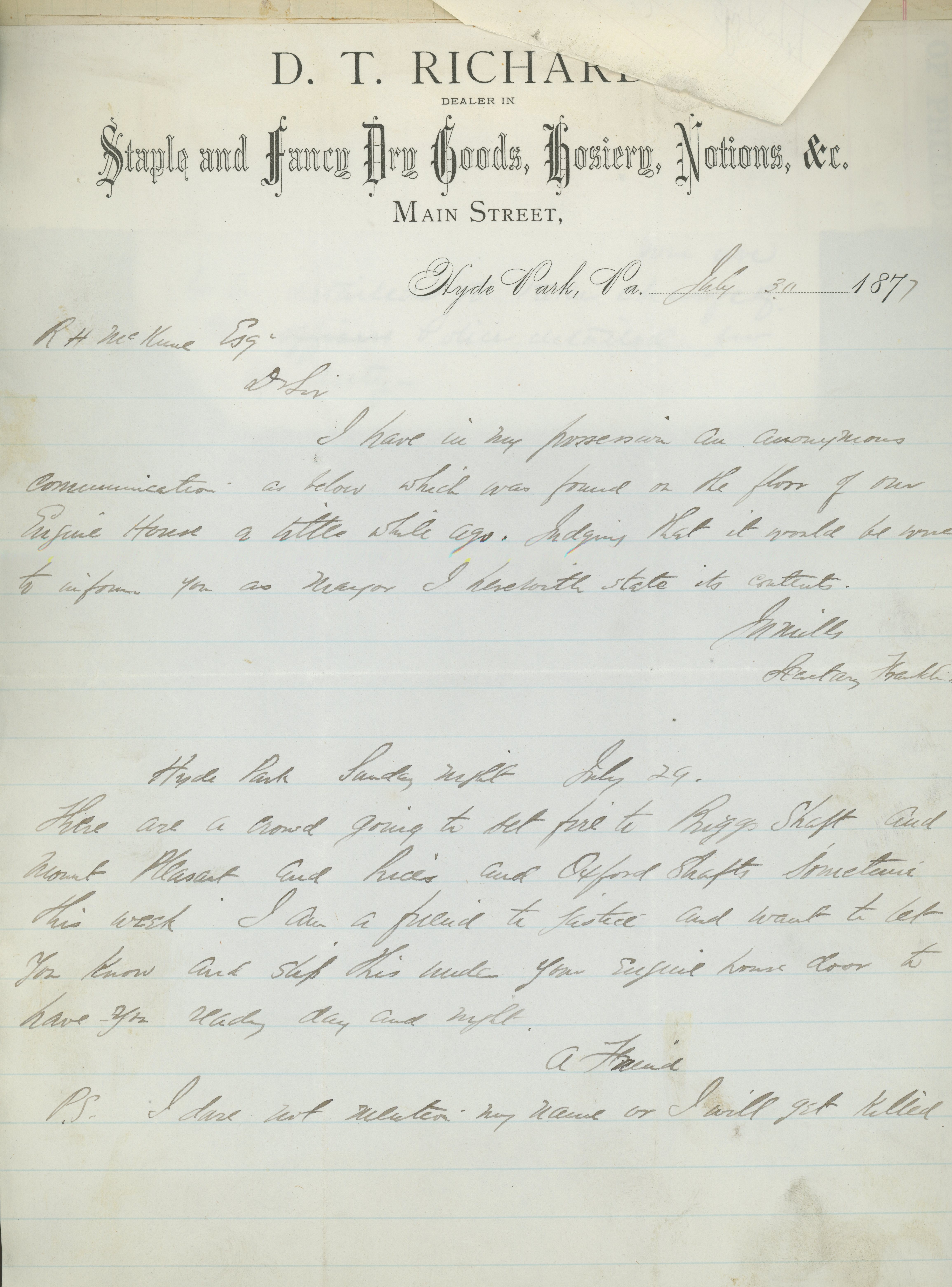
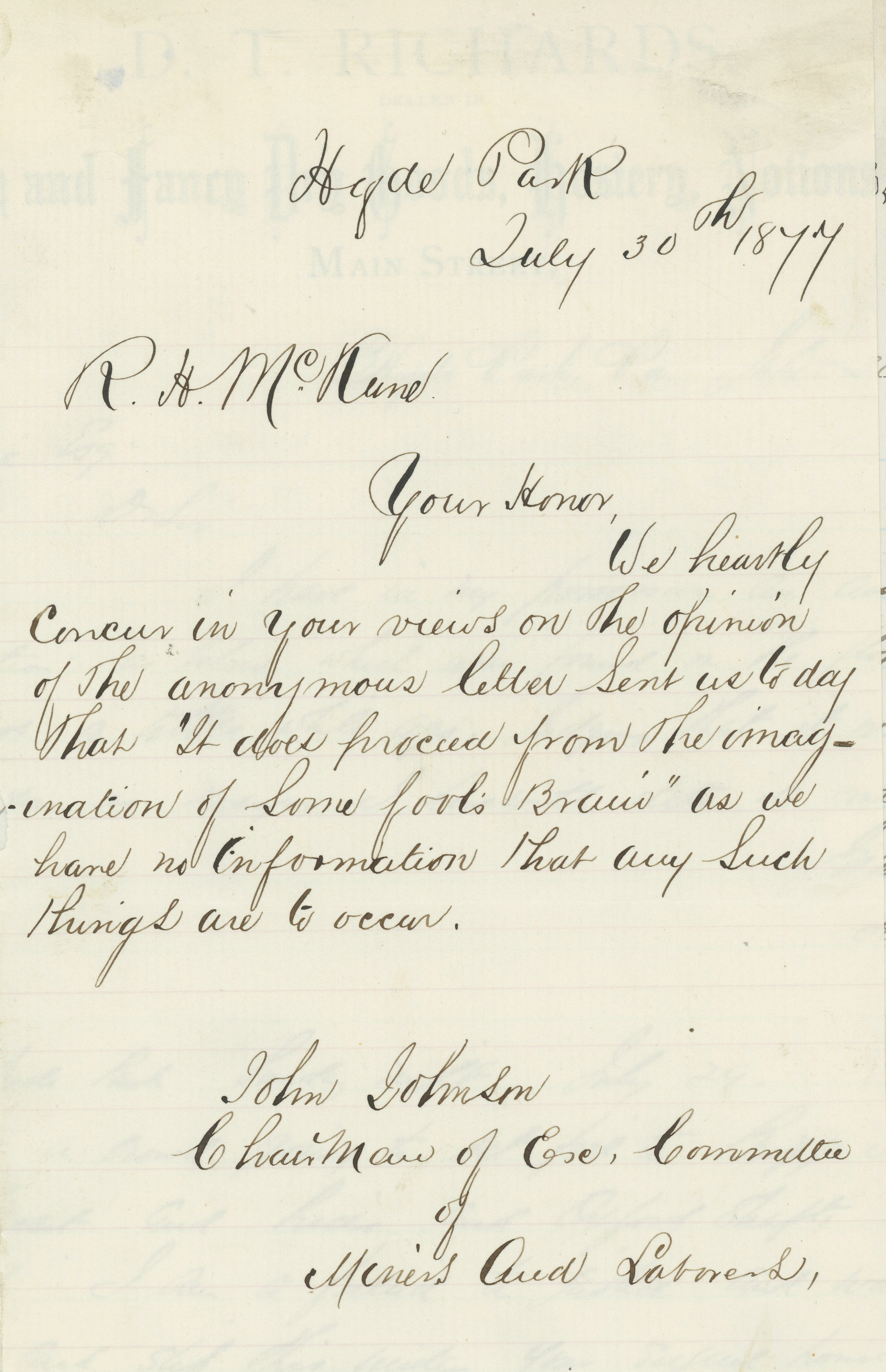
Although the day remained peaceful, an anonymous letter claiming fires would be intentionally set at mine shafts in the area was left in the engine room of Staple and Fancy Dry Goods, Hosiery, Notions, &c. located on Main Street in Scranton. In communications between Mayor McKune and John Johnson, the chairman of the Esc. Committee of Miners and Laborers, it is determined that this is a false threat.

I have in my possession an anonymous communication as below which we found on the floor of our Engine Room a little while ago. Judging that it would be wise to inform you as Mayor I herewith state its contents J.M. Mills, Secretary Hyde Park, Sunday Night, July 29 There are a crowd going to set fire to Riggs Shaft and Mount Pleasant and Rice’s and Oxford Shafts sometime this week. I am a friend to justice and want to let you know and slip this under your engine house door to have you ready day and night. A friend P.S. I don’t mention my name or I will get killed.
Hyde Park, July 30, 1877 R.H. McKune Your Honor, We heartily concur in your views on the opinion of the anonymous letter sent us today that that it does proceed from the imagination of some fool’s Brain as we have no information that any such things are to occur John Johnson Chairman of Esc. Committee of Miners and Laborers
Categories
Albright Memorial Library Lackawanna County Library System

Great Railroad Strike of 1877: July 27th (Series: Part 5)

The rising tensions of July 27, 1877 are reflected in the letters and telegrams found in Mayor McKune’s papers.

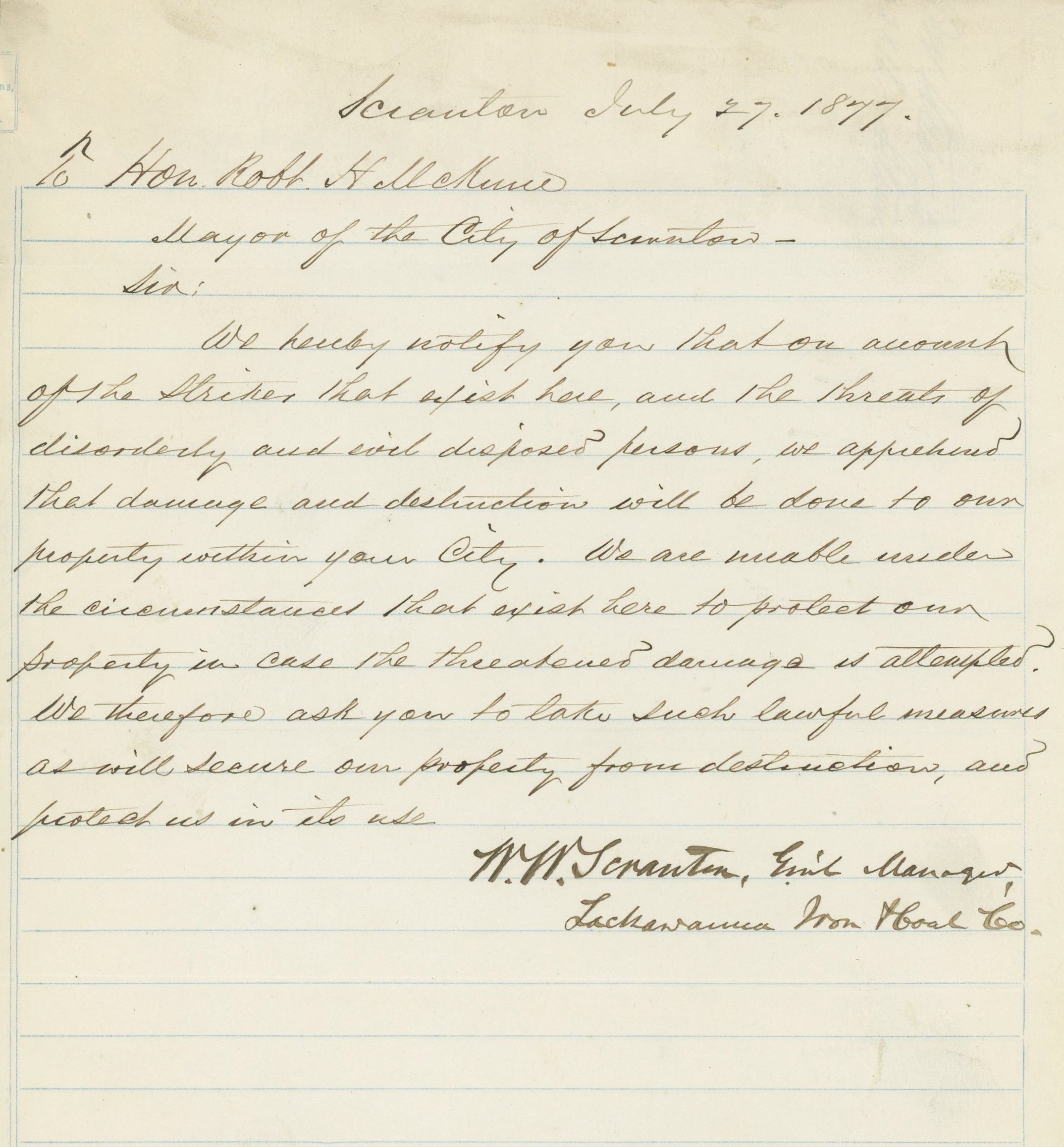
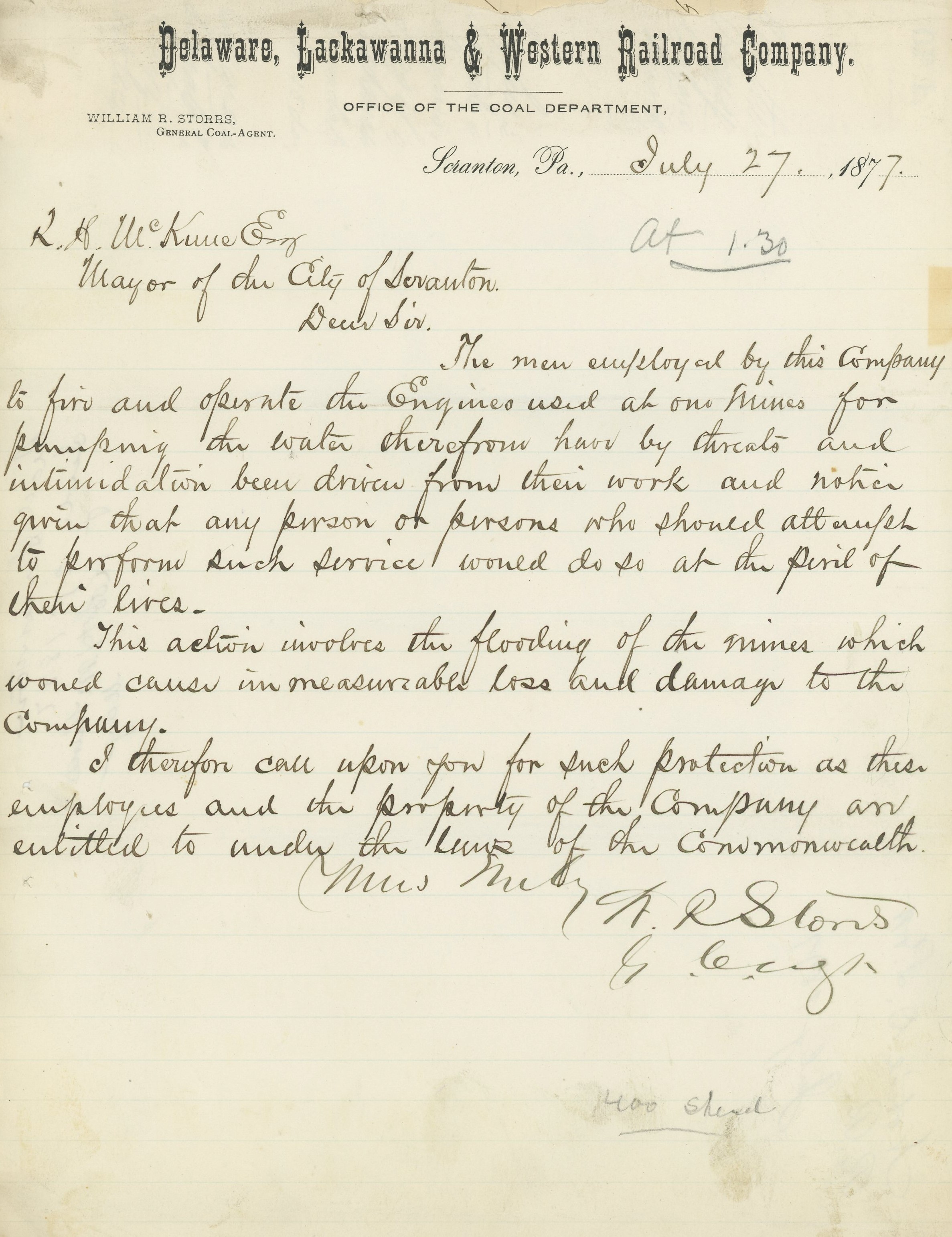
On July 27th, Mayor McKune met with the Brotherhood of Trainmen to discuss a potential return to work. Railway workers, firemen, brakemen, and mill workers accepted a return to work agreement for their wages before the most recent cut. The miners who worked for the coal companies refused these terms and continued to strike. Those still participating in the strike issued threats of violence against the railroad companies, coal companies, and those returning to work.

We hereby notify you that on account of the Strikes that exist here and the threats of disorderly and evil disposed persons, we apprehend that damage and destruction will be done to our property within your city. We are unable under the circumstances that exist here to protect our property in case and the threatened damage is attempted. We therefore ask you to take such lawful measures as will secure our property from destruction and protect us in its use. W. W. Scranton, Genl. Manager Lackawanna Iron & Coal Co.


The men employed by this Company to fire and operate the Engines used at our mines for pumping the water therefrom have by threats and intimidation been driven from their work and notice given to any person or persons who should attempt to perform such services would do so at the peril of their lives This action involves the flooding of the mines which would cause immeasurable loss and damage to the company. I therefore call upon you for such protection as these employees and the property of the Company are entitled to under the laws of the Commonwealth. W R Storrs


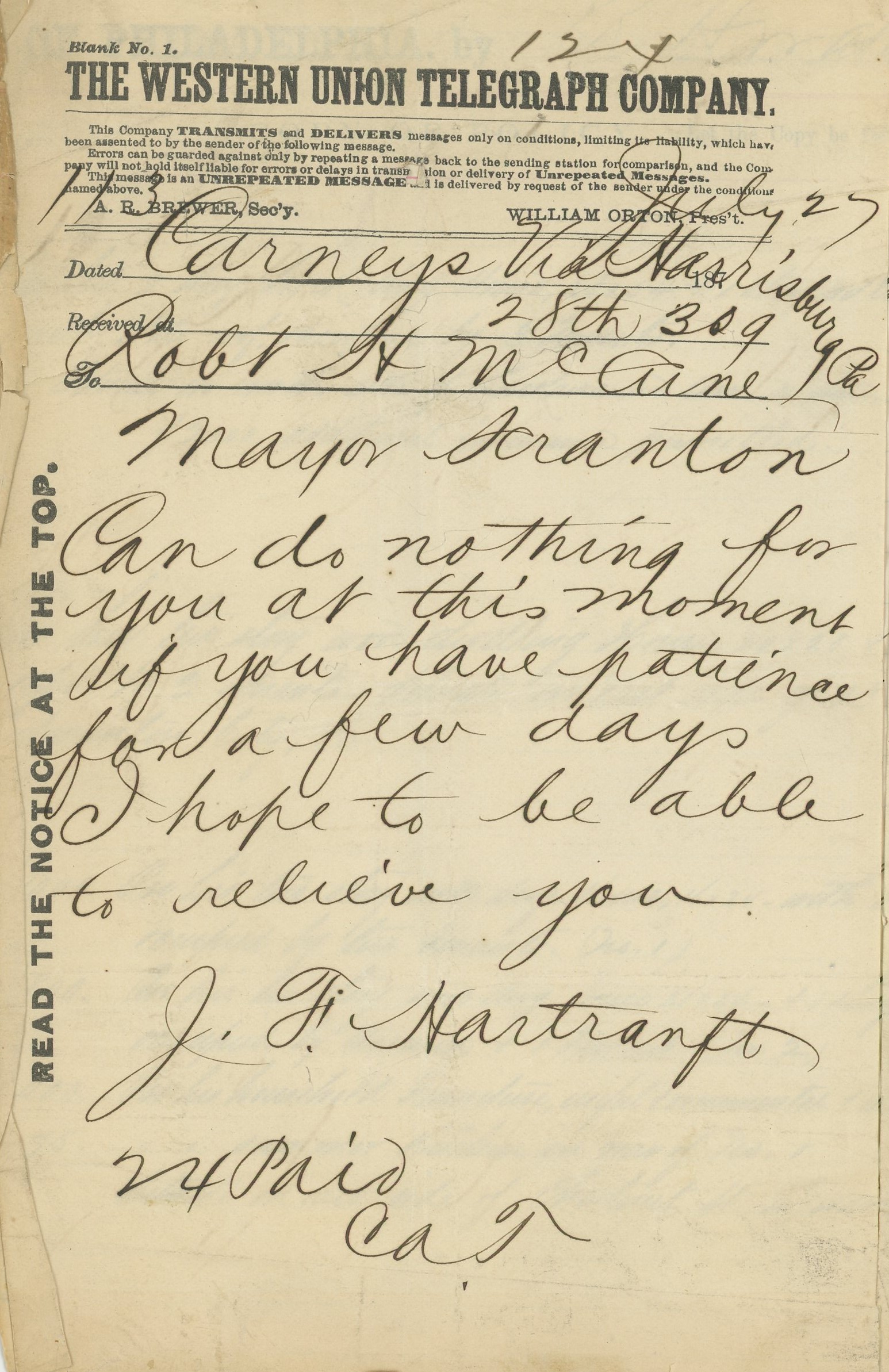
With these fears in mind, the Scranton Citizen’s Corps obtained permission from General Osborne to obtain arms. Minor acts by strikers, including turning off mine pumps to prevent flooding and threats, compounded these worries in the minds of those in charge of the companies and the city. Mayor McKune sent telegrams requesting assistance to Governor Hartranft, but he was not able to help at the time.

The DLW RR Co. have asked me for aid to prevent their mines form being flooded and otherwise destroyed. I am unable to render the assistance required. Can you have sent here a body of U.S. Troops. The militia are in sympathy with the strikers, and in the opinion of our advisory committee would be of no avail. The presence of U.S. Troops in my opinion would secure the desired purpose without a conflict. Robert H. McKune Mayor


Can do nothing for you at this moment. If you have patience for a few days I hope to be able to relieve you. J. F. Hartranft
Categories
Albright Memorial Library Lackawanna County Library System

Great Railroad Strikes of 1877: July 26th (Series: Part 4)

The events of July 26, 1877 focused on preparing for the anticipated clashes between strikers, and the military presence in Scranton. The relatively calm day is reflected in Mayor McKune’s papers though a telegram to Governor Hartranft and letter from the Central Railroad Company of New Jersey.

Mayor McKune proposed a special police group, that would later be renamed the Scranton Citizen’s Corp, to help respond to the strikes. In order to sign up for the newly created police force, a citizen was required to be a businessman, be willing to defend the city, and keep the group a secret from other members of the community. Many people notified of its creation believed that such measures might further incite violence and refused to join. By the end of the day, 116 men had signed up and Ezra H. Ripple was elected captain of the Scranton Citizen’s Corps.

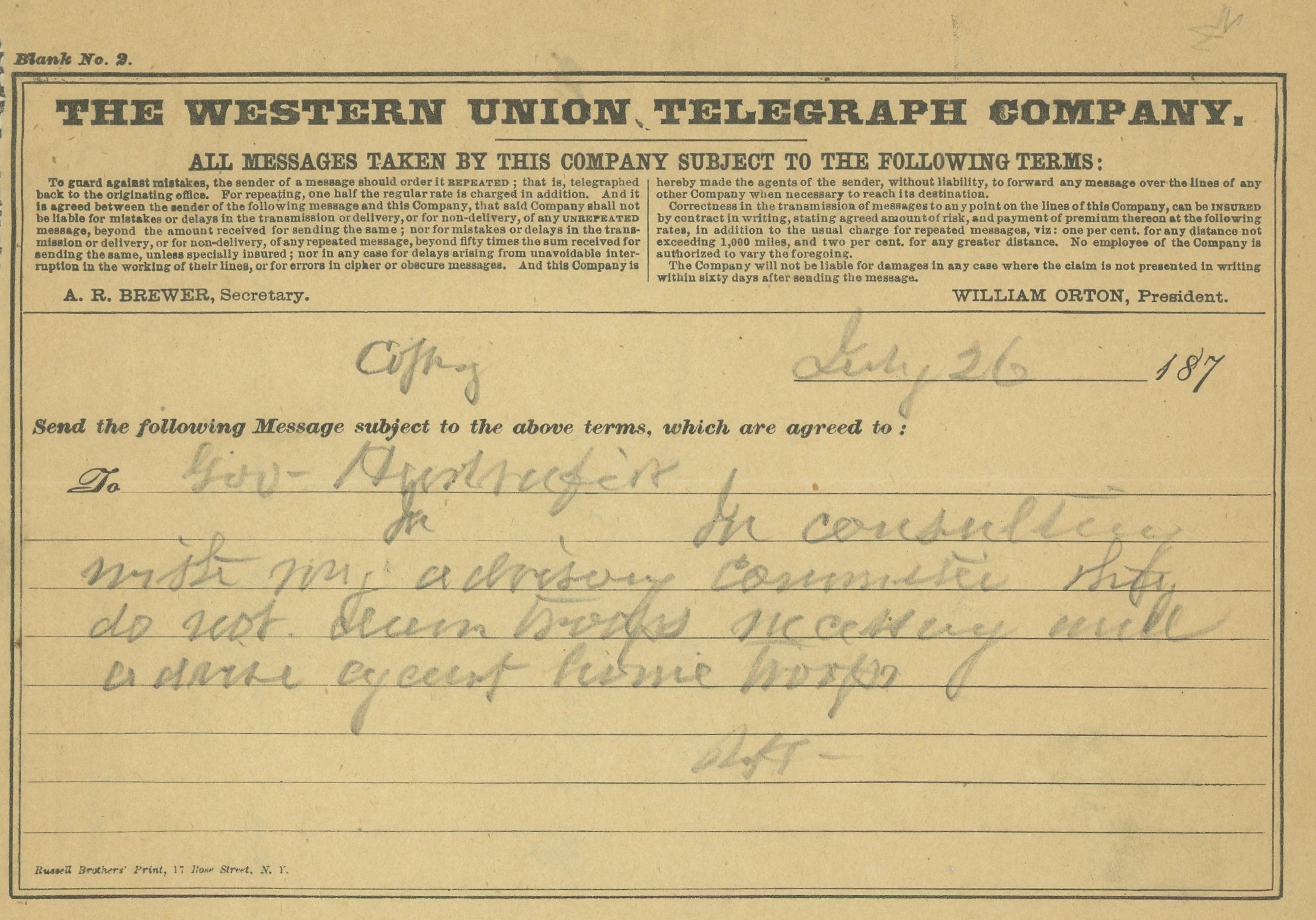
During these events, Mayor McKune contacted Governor Hartranft to let him know that troops would not be necessary in the city that day.


In consulting with my advisory committee. They do not deem troops necessary. Will advise against home troops.


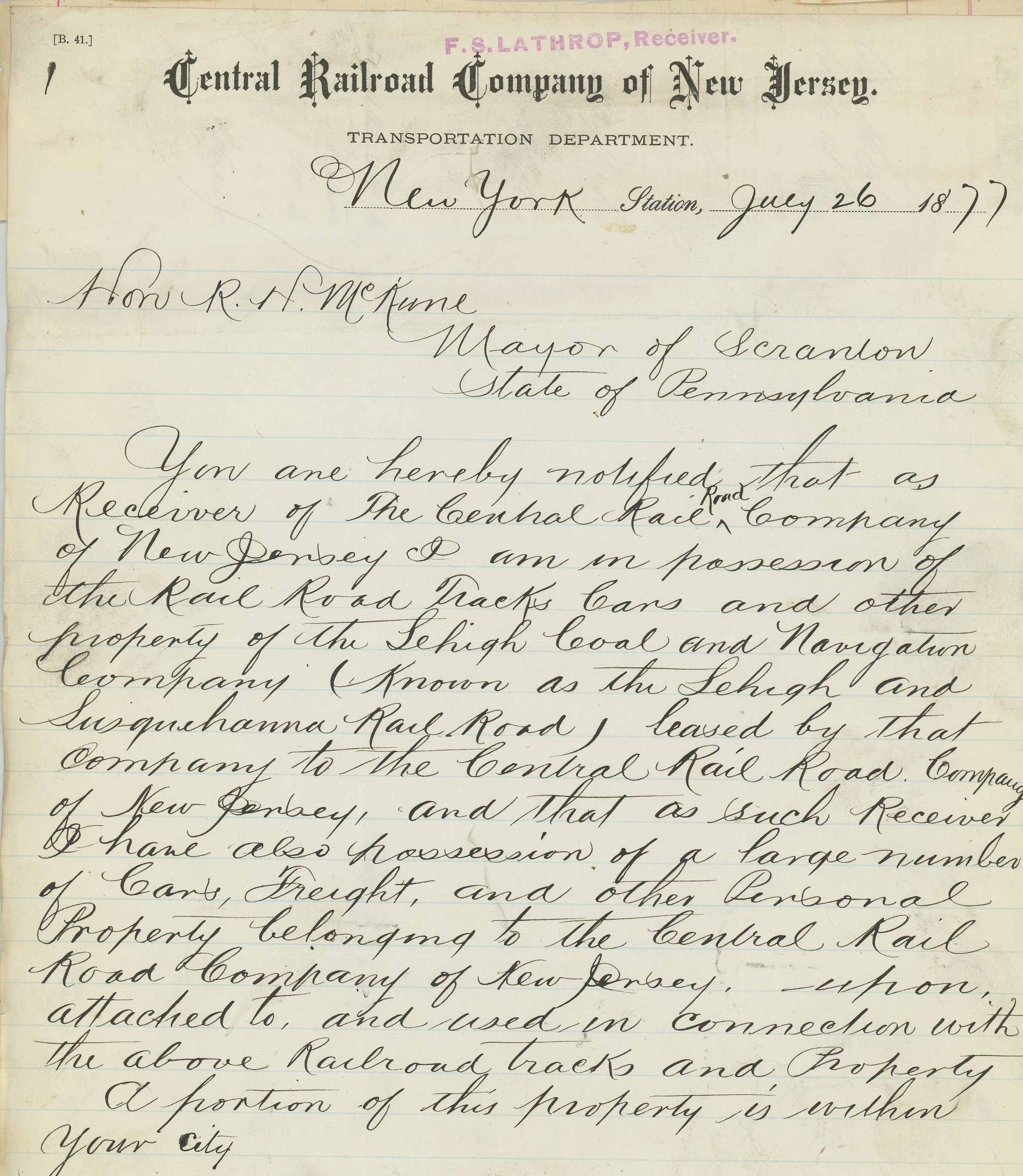
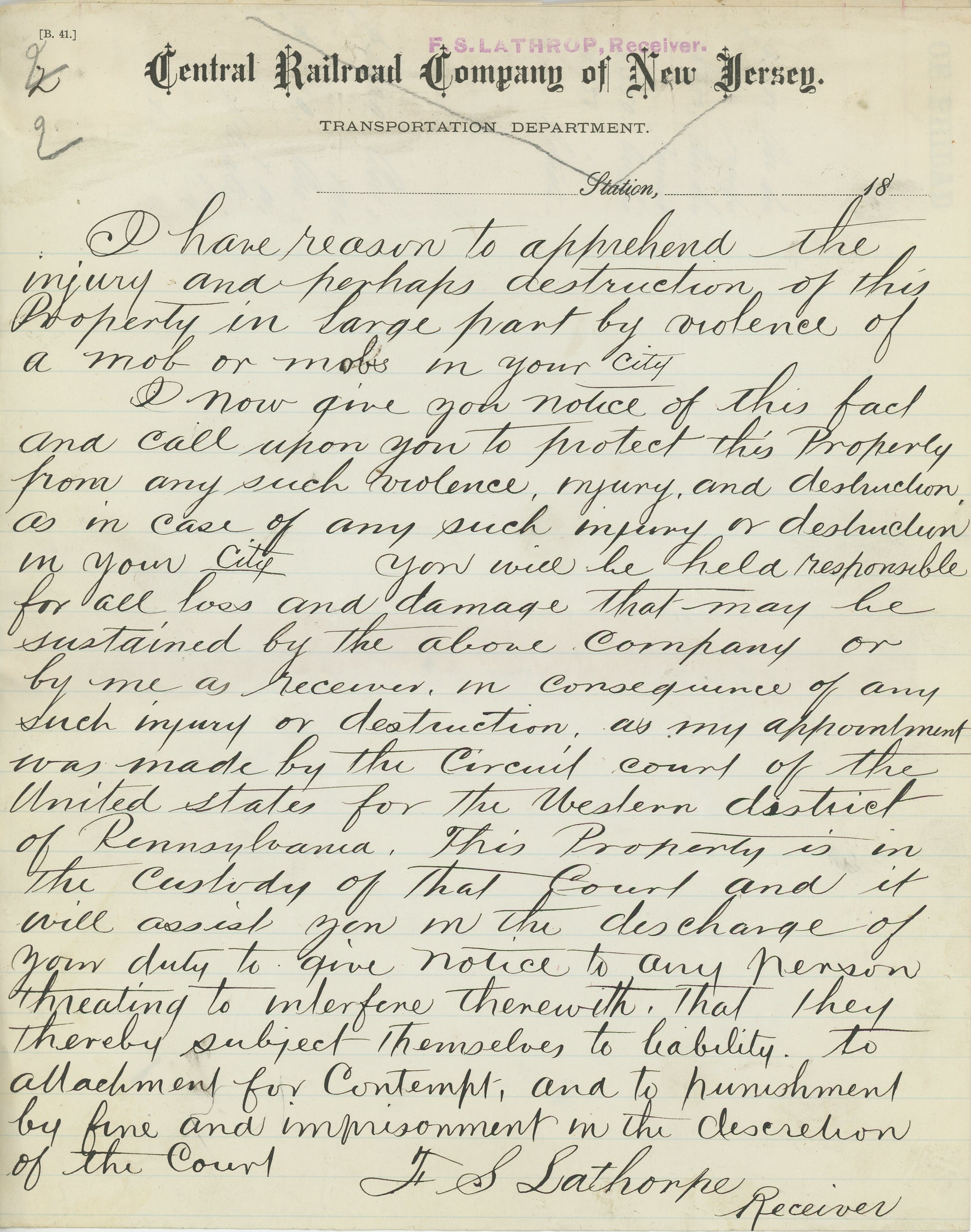
The potential property damage caused by the Great Railroad Strike of 1877 continued to weigh on the mind of those in the city. Mayor McKune received a letter from the Central Railroad Company of New Jersey stating that the city was responsible for any damage, violence, or injuries resulting from the strikes in Scranton. Similar letters would be issued from other railroad and coal companies throughout the day.

You are hereby notified that as Receiver of the Central Railroad Company of New Jersey I am in possession of the Rail Road Tracks, Cars, and other property of the Lehigh Coal and Navigation Company (known as the Lehigh and Susquehanna Rail Road) leased by that company to the Central Rail Road Company of New Jersey and that as such Receiver of Cars. Freight, and other Personal Property belonging to the Central Rail Road Company of New Jersey upon, attached to and used in connection with the above Railroad tracks and property. A portion of the property is within your city.
I have reason to apprehend the injury and perhaps destruction of the Property in large part by violence of a mob or mobs in your city. I now give you notice of this fact and call upon you to protect this Property from any such violence, injury, and destruction as in case of any such injury or destruction in your city. You will be held responsible for all loss and damage that may be sustained by the above company or by me as receiver in consequence of any such injury or destruction. As my appointment was made by the Circuit court of the United States for the Western district of Pennsylvania. This Property is in the custody of that court and it will assist you in the discharge of your duty to give notice to any person threatening to interfere wherewith. That they thereby subject themselves to liability to attachment for Contempt and punishment by find and imprisonment in the discretion of the court. F. S. Lathrope Receiver
Categories
Albright Memorial Library Lackawanna County Library System

Great Railroad Strike of 1877: July 25th (Series: Part 3)

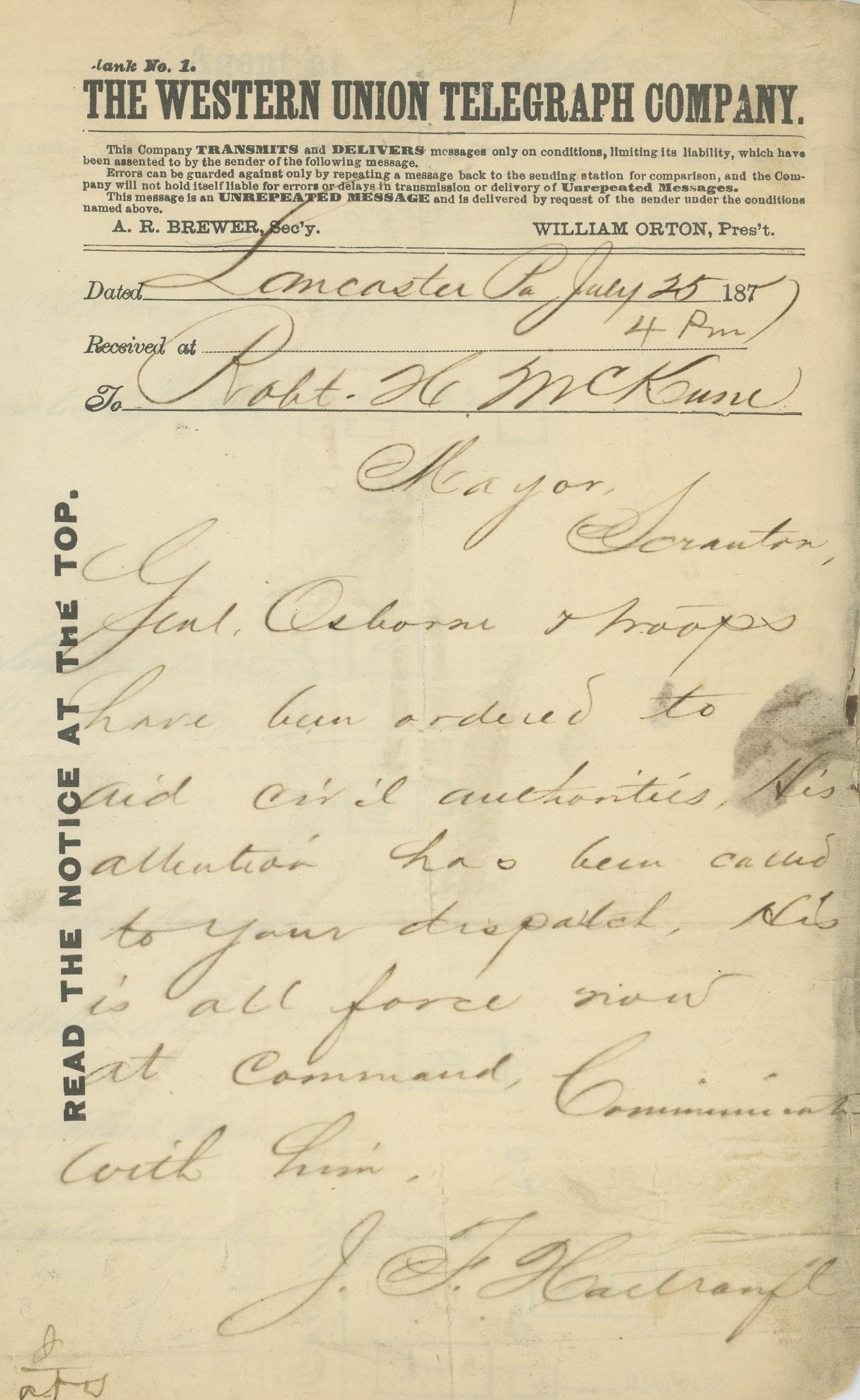
Mayor McKune’s papers related to the Great Railroad Strike of 1877, begin on July 25, 1877 with a proclamation issued by Mayor McKune and a telegram from Governor John F. Hartranft.

Railway workers and miners continued to strike and make demands for the increase of wages throughout July 25, 1877. Leaders of industry including William R. Storrs of Delaware, Lackawanna, and Western Railroad and William Walker Scranton of Lackawanna Iron and Coal refused citing the ongoing economic troubles resulting from the Panic of 1873.

Citizens of Scranton began to worry that family members vacationing elsewhere would not be able to return home due to the strikes. For the local officials, the fact that troops who had been previously protecting the city had been ordered to different parts of Pennsylvania to quiet the strikes happening there. This situation mixed with a lack of communication would lead to the violence and unrest in the coming days.

Fear of unrest resulted in Mayor McKune issuing a proclamation to close any location that sold liquor believing the lack of alcohol would deter the strikers from turning violent.

MAYOR’S OFFICE Scranton, Pa. July 25, 1877 The general public opinion as expressed to me seems not apprehend any violence or danger unless a too free use of liquor shall be indulged in, and the earnest re-quest of the committees from the workingman’s organizations and others who have called upon me this morning requesting me to close all places where liquor is sold, I therefore, in compliance with said re- quest, ask of you to close your bars, and to strictly abstain from selling of all kinds of liquor for the present R. H. McKune, MAYOR

By 4 p.m., Mayor McKune secured support for the City in the form of General Edwin Sylvanus Osborne and the Third Division of the National Guard through communication with Governor John F. Hartranft.

Genl Osborne and troops have been ordered to aid civil authorities. His attention has been called to your dispatch. His is all force now at command, communicate with him.
Categories
Albright Memorial Library Lackawanna County Library System

Great Railroad Strike of 1877: Notable People in Mayor McKune’s Papers (Series: Part 2)

In order to understand Mayor McKune’s papers on the Great Railroad Strike of 1877, the backgrounds of the major figured he corresponded with or about should be examined. Many of the figures are veterans of the Civil War or prominent businessmen from the history of Scranton, Pennsylvania. Where available, a photograph is included with a brief biography of each person. They are arranged in alphabetical order by last name below.


General Robert Morton Brinton
General Brinton was the commander of the First Division of the National Guard of Pennsylvania in Philadelphia. During the Great Railroad Strike of 1877, he was sent from Pittsburgh to Scranton to impose martial law on the city.  He brought about 3,000 troops with him to accomplish his goal.


Governor John Frederick Hartranft
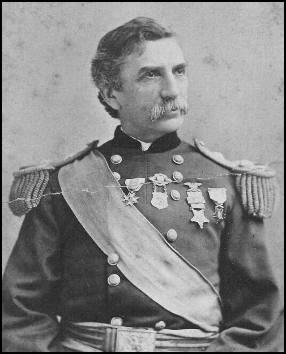
Governor John Hartranft was born in North Hanover Township, Pennsylvania. He briefly worked for railroad companies, his father’s real estate business, and the Pennsylvania Militia. During the Civil War, Hartranft was involved in the Battle of Antietam, Battle of Fredericksburg, Battle of Vicksburg, and more. He was appointed the commanding officer of the Old Capitol Prison and provost marshal during the trial of the Lincoln assassination conspirators. In Pennsylvania, he served as the Auditor General before being elected as Governor in 1872. During the Great Railroad Strike of 1877, Hartranft oversaw the organization of local militias to quiet the strikers. After his position of Governor, he was the US Postmaster, Port Collector of Philadelphia, and commander of the Pennsylvania National Guard. Governor Hartranft died in January of 1879.


General Edwin Sylvanus Osborne
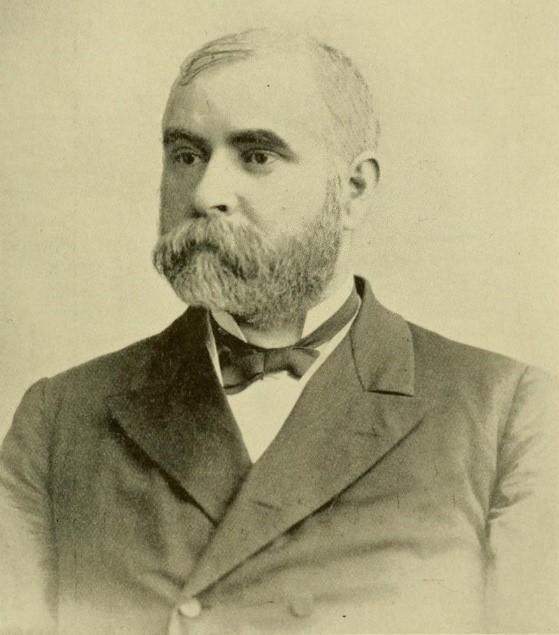
A native of Bethany, Pennsylvania, General Osborne moved to Northeastern Pennsylvania to practice law in Wilkes-Barre, Pennsylvania. In 1870, he was appointed to be major general of the National Guard, Third Division of Pennsylvania after his honorable discharge from the Union Army in July of 1965. After his involvement in the Great Railroad Strike of 1877, he was elected Republican Congressman, continued to practice law in Wilkes-Barre, and is buried in Arlington National Cemetery.


Ezra H. Ripple
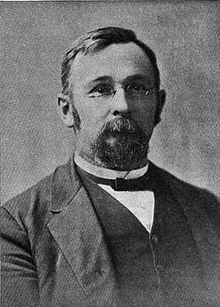
Ezra H. Ripple was born in Mauch Chunk, Pennsylvania. During the Civil War he was captured and spent three months in Andersonville Prison before being transferred to Florence Stockade. Ripple managed to escape the prison to be honorably discharged in 1865. After the War, he worked in the crockery business as a partner of the William Connell & Company. During the Great Railroad Strike of 1877, he was elected as the captain of the Citizens’ Corps and served as colonel when the corps was reorganized into a regiment of the Pennsylvania National Guard. He became the treasurer of Lackawanna County in 1879, and Mayor of Scranton in 1886. He died in November of 1909.


William Walker Scranton
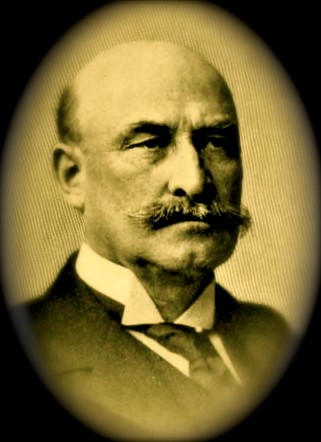
William Walker Scranton was born in Augusta, Georgia, but moved to Scranton, Pennsylvania in 1847. He was the manager of Lackawanna Iron and Coal Company, which he managed through the Great Railroad Strike of 1877. During that time period, he also allowed the Scranton Citizens’ Corps to store their arms in buildings he owned. After the strikes, Scranton founded the Scranton Steel Company and became the manager of the Scranton Gas and Water Company. He is buried in Dunmore Cemetery.
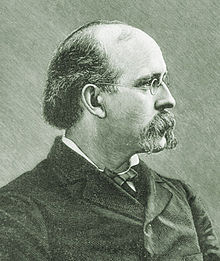
 

Categories
Albright Memorial Library

Great Railroad Strike of 1877 and Mayor Robert H. McKune (Series: Part 1)

Recently, the Scranton Public Library’s Reference Department became aware of documents from former Scranton Mayor Robert H. McKune in our collection. Before becoming Mayor, McKune traveled to California during the Gold Rush, fought in the Battle of Antietam during the Civil War, and was appointed as a U.S. commissioner. In 1875, he was elected as Mayor of Scranton and is most known for his role in the Great Railroad Strike of 1877. Many of the documents found in the collection pertain to the Railroad Strike and his personal role in the events of that year.

Economics were the main cause of the Great Railroad Strike of 1877. During the Civil War, railroads became a major industry in the United States. Many companies were able to grow businesses, expand, and employ large sections of the population providing a reliable and stable source of income. The booming industry started to massively decline in the early 1870s when a series of economic problems began to affect the United States.  Resulting from property damage sustained in the Chicago and Boston Fires, world events, and the switch to the Gold Standard, a significant drop in bank reserves in the United States occurred. This was the beginning of The Panic of 1873, or the Long Depression, that lasted until 1879.

The Great Railroad Strikes of 1877 began in West Virginia where the Baltimore and Ohio Railroad cut wages by 10%, which was the second time in eight months. Railroad companies cited the ongoing economic crisis as a reason for the cuts. On July 16, 1877 the already poorly paid workers decided to strike and stop trains from leaving the B&O station. These actions quickly spread across the country, most notably to Pittsburgh where the Pennsylvania National Guard and Federal Troops were utilized to end the strikes

Locally, in both 1874 and 1876, mine workers’ wages were slashed 10% and 15% respectively resulting in smaller strikes. These cuts also impacted railway workers due to the lack of transportation of coal from the area. On July 23, 1877, workers of the Delaware, Lackawanna, and Western Railroad Company and Lackawanna Iron and Coal Company walked off the jobs due to the most recent cuts to their wages. With almost every industry in the city at a standstill, meetings between workers and company managers began to happen. Workers wanted a raise in wages, which the railroad and coal companies refused. The strikes marked by periods of unrest and violence would continue through October.

Over the course of the next month, the Reference Department of the Scranton Public Library will be sharing a selection of the letters, telegrams, and proclamations found in Mayor McKune’s papers on the dates they were written or issued.  The posts will focus on the period of unrest in the city from late-July through August that resulted from the Great Railroad Strike 1877. Join us as we explore and learn about the history of Scranton.